British Industrial Competitiveness Scheme: everything you need to know

The British Industrial Competitiveness Scheme (BICS) is an initiative from the Department for Business and Trade (DBT, now the Department for Business, Innovation, Science, and Trade (BIST)). For clarity, we’ll refer to the department as BIST in this piece. BICS will lower electricity costs for a range of British manufacturing frontier and foundational industries from April 2027, enhancing their competitiveness.
Read on to understand which businesses will be eligible for the scheme, how the BIST apply exemptions, and to understand Drax Energy Solutions’ approach to delivering the scheme.

Which businesses are eligible for BICS?
In summary, to be eligible for BICS, businesses must:
- Operate within an eligible SIC code; and
- Produce eligible products confirmed via use of HS6 codes,
- Have a minimum 33MWh/annum per site grid consumption, and
- Have a Companies House registration.
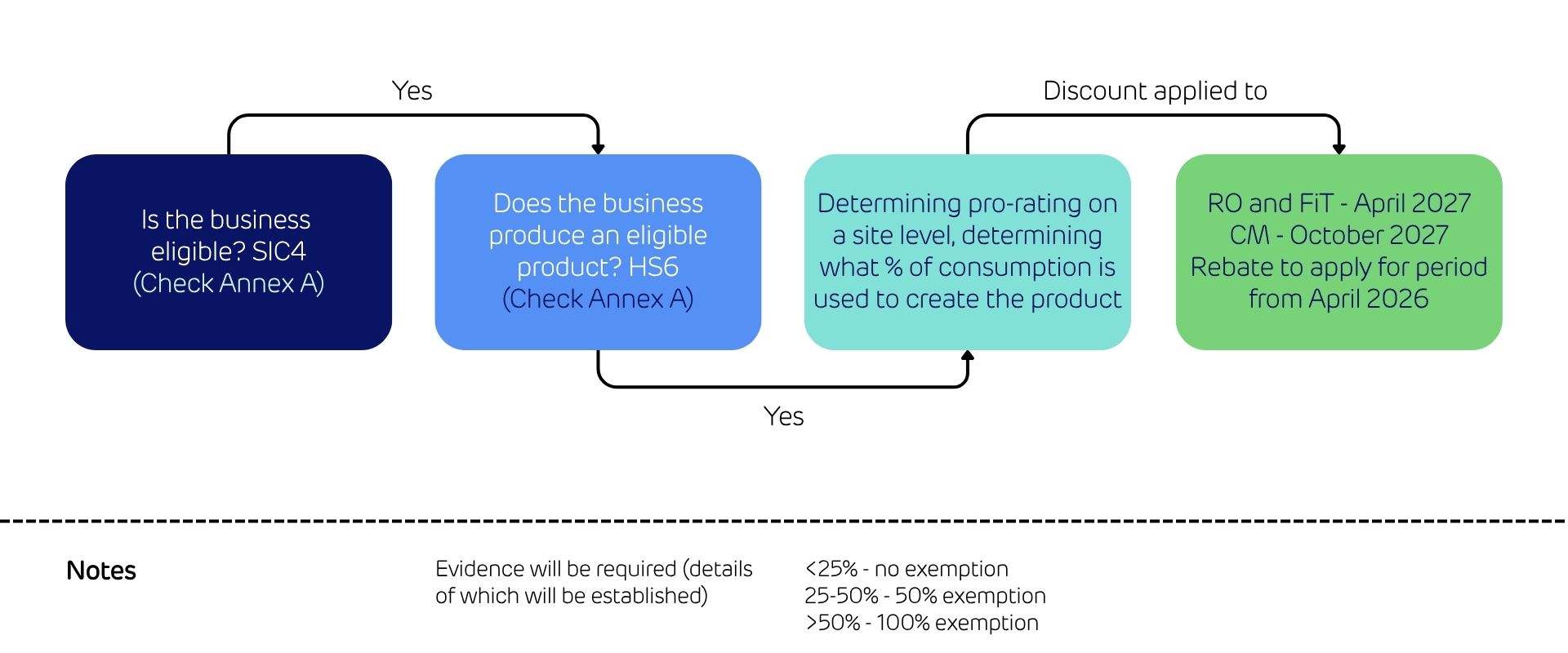
For BIST to consider businesses eligible, businesses need to have registered their company on Companies House. Those businesses that need to record their Standard Industrial Classification (SIC) code on Companies House will have this information used to determine their eligibility, with further evidence to confirm this. BIST recognise that not all businesses have a recorded SIC code. These will still be able to apply, with further information on the required evidence to be set out in guidance.
84 SIC codes will be eligible for BICS, which BIST have published on its BICS consultation page. The electricity intensity test thresholds that the Government used for setting the eligible SIC codes are lower than those used for energy intensive industries at:
- 0.9% for manufacturing frontier industries
- 2.7% for manufacturing foundational industries
Businesses wanting to determine whether they produce an eligible product should refer to the final list of eligible six-digit harmonised system (HS6) codes. BIST will publish an online checker to help businesses self-assess their eligibility. Applicants will need to provide evidence of the eligible products they manufacture and energy consumption for the site from the network.
BIST confirmed the annual minimal consumption threshold to be eligible for BICS is 33MWh per year, determined at the site level. Ofgem’s definition of a micro business is 100MWh per year, keeping the scheme widely accessible for businesses. The threshold applies to electricity imported from the grid rather than total site consumption. Businesses which receive their electricity from a third party’s private network (e.g. a landlord) will be eligible for the scheme. DBT has pledged to work with its delivery partners to explore ways to accommodate businesses with private network arrangements from year 2 of the scheme onwards.
What electricity bill exemptions will BICS provide?
- Exemption from the Capacity Market (CM), Renewables Obligation (RO), and Feed-in Tariff (FiT) bill components from 2027.
○ This is a £53/MWh saving at 100% exemption in 2027, according to our forecasts. - Eligible businesses receive a rebate payment to reimburse equivalent costs from April 2026.
- Thresholds exist for those that use power for more than one process or purpose on a site, meaning sites could see a 0%, 50%, or 100% exemption (see below for detail)
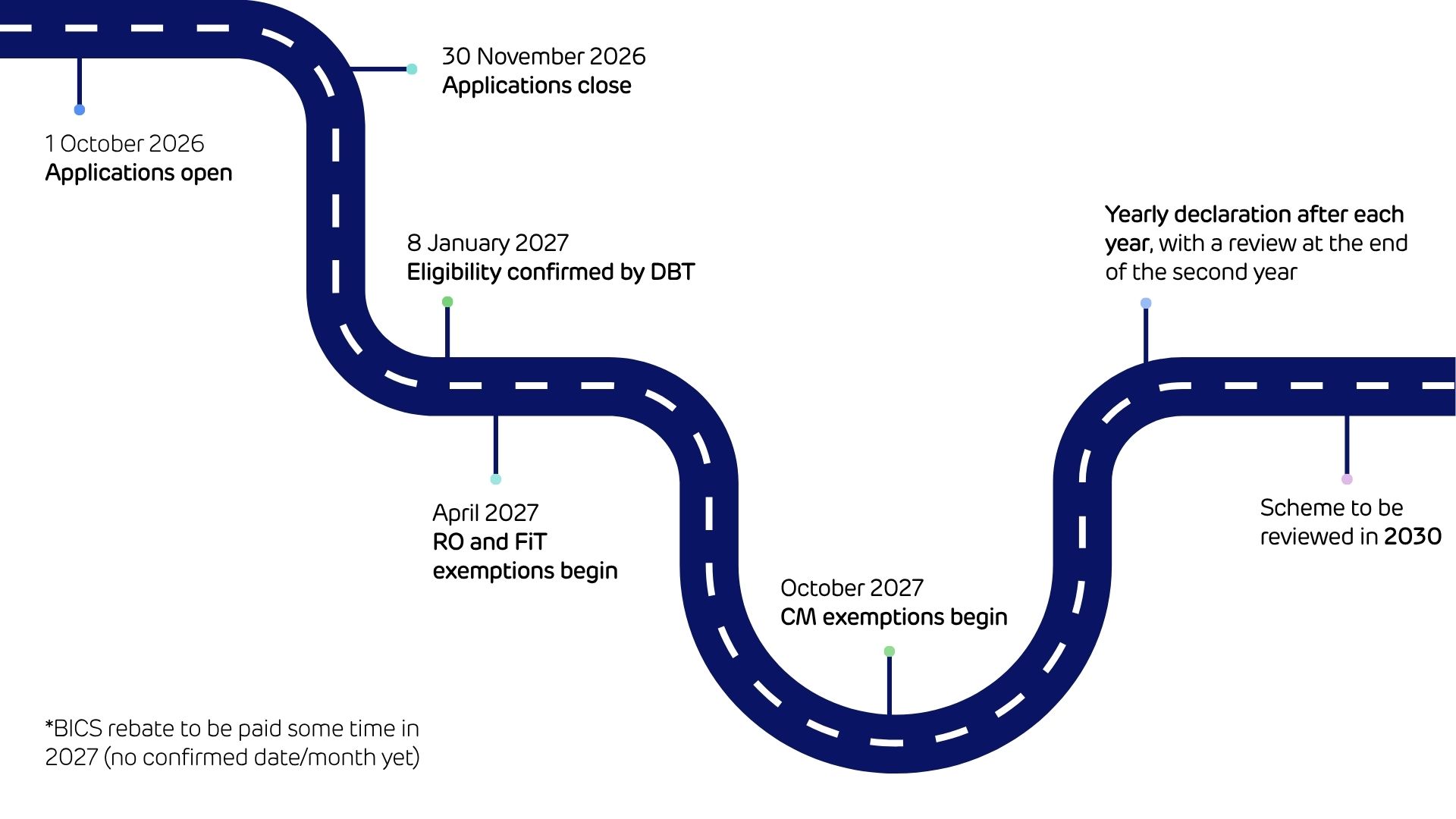
Eligible businesses will be exempt from the costs of the RO, CM and FiT. RO and FiT exemptions will apply from April 2027, while the CM exemption will apply from the start of the CM delivery year in October 2027.
DBT will award a 50% exemption to those using between 25% and 50% of consumption at the site for eligible processes. Sites using 50% or more of consumption for eligible processes will get a 100% discount.
The Government has stated that it’ll fund the scheme through a combination of Exchequer funding which it’ll use for financial year 2026-27, and changes to the energy system. The Government has said this means that other consumers’ bills won’t go up to compensate for BICS. These changes include the removal of the Carbon Price Support (CPS) from 2028, which adds carbon costs to fossil-fuel fired wholesale energy costs.
Eligible businesses will also receive a rebate for the costs they would have paid, had the scheme been in operation from April 2026. The Government will make this payment in 2027 as a singular lump sum payment through a bill credit mechanism. For businesses where this is not suitable, the Government has promised to work with electricity suppliers and businesses to “understand the best mechanism to deliver payments effectively”. The Exchequer will fund these payments, with funding delivered to suppliers for distribution to businesses. These payments won’t be adjusted subject to RO, CM or FiT reconciliation settlement processes.
BICS application timeline: key dates for 2026 and 2027
How will the BICS application work?
The first year of the scheme will use a time-limited identification window, running from 1 October 2026 to 8 January 2027 with applications closing on 30 November 2026. BIST will confirm all eligible businesses by the second week of January. Complex cases may extend to the end of the month, with BIST notifying suppliers and businesses if this occurs. For subsequent years, businesses will be able to apply and receive eligibility for BICS in a year-round open window. There will be no mid-year entry, eligible businesses will only join the scheme at the start of each delivery year (April for FiT and RO, October for CM). There will be a clear cut off date each year for the delivery year ahead which will be set by BIST.
BIST confirm that, once determined, eligibility will last for five years with a review at the end of the second year. Businesses will need to complete an annual declaration to confirm that there have been no changes in circumstances. Businesses will be responsible for providing evidence, including those who use a third party’s private network. This includes MPAN, 6 months consumption data per site, and the proportion of exempt manufacturing at the site. Changes that affect eligibility may result in BIST revoking exemptions.
Robust data quality, standardisation and central coordination are critical for the scheme. BIST therefore assumes that delivering bodies will use a centrally managed dataset using the BICS digital service. The dataset will provide eligibility at an MPAN level, with BIST encouraging automated integration using APIs. BIST are yet to announce data specifications and guidance, but will set these out before it implements the scheme.
How Drax Energy Solutions will support customers with BICS
We’ll pass through 100% of the savings to customers.
Based on our central TPC forecasts for 2027/28, we estimate the full (100%) exemption to be £53/MWh across FiT, RO and CM. This equates to approximately 20% of a customer’s total electricity bill.
Next steps for businesses expecting BICS eligibility
BIST will shortly publish comprehensive business guidance, setting the application process and evidence requirements out in detail. The Government will also launch a digital eligibility tracker tool to allow businesses to quickly identify whether they will be eligible for BICS.
BIST has also pledged to continue to explore using forecasted electricity consumption data for the second year of the scheme, allowing new sites or sites looking to electrify to participate in the scheme.
The Government plans to amend existing secondary legislation relating to the RO, CM and FiT in the Autumn, subject to parliamentary approval and subsidy control procedures. BIST will also publish a full impact assessment alongside the statutory instruments which will cover funding arrangements and impacts of the scheme.
Disclaimer
We’ve used all reasonable efforts to ensure that the content in this article is accurate, current, and complete at the date of publication. However, we make no express or implied representations or warranties regarding its accuracy, currency or completeness. We cannot accept any responsibility (to the extent permitted by law) for any loss arising directly or indirectly from the use of any content in this article, or any action taken in relying upon it.
Subscribe to our Intelligence newsletter
Stay up-to-date with all the latest energy industry news, with expert analysis from our Sales Energy Market Lead, Dan Starman, and other industry professionals.

